Product-Market Fit Isn’t Enough: Edtech’s Real Growth Metric
Michael E. Spencer is the CEO and Founder of Global Expansion Strategies, a Silicon Valley based international, advisory, growth and investment firm working with early to mid-stage education companies to expand globally. Michael Spencer is an education executive with more than 30 years of global C level leadership, management, operational, business development and investment experience in the K-12 marketplace. In addition to serving as Senior Director of International Business Development at K12 Inc. and Senior Vice President of American Education Corporation, he has founded, co-founded and been a board member and advisor for numerous EdTech companies, including ASSIST Education, One2OneMate LLC, QuickPAD Technology Corporation, H45 Technology Corporation, and The Minden Group LLC. All achieved 100%+ growth year-over-year since inception, received multiple awards for innovation and led to A and B rounds of funding as well as successful exits.
EDTECHEDUCATION TECHNOLOGYSAAS


There’s a classic founder truism: first-time founders are obsessed with product, second-time founders are obsessed with distribution.
What does this mean? First-time founders will focus on developing a great product. They believe that if you build a superior product, customers will naturally come to it. But, the difference between first- and second-time founders is that second-time founders understand a great product isn’t enough. Second-time founders know that they need to have a plan for how their product will get into the hands of their users and customers from day one.
This is especially true for edtech, and here’s why.
Introducing ‘Customer-Market Fit’
Everyone talks about Product-Market Fit (PMF). And for good reason – it’s the first sign that you’ve built something people actually need. But the reality is that PMF gets you attention. It doesn’t get you scale or the sustainable, recurring revenue required for your business to survive and generate transformational impacts for learners and educators.
Many first-time founders in edtech come from education backgrounds and believe that developing a superior pedagogical alternative is the key to success, because that is the key to user impact. But in edtech, success and impact are not exactly the same thing, because education purchasers suffer from major macro challenges.
We all know the uncertainties of the US domestic K-12 market, especially now that ESSER funding is done. Meanwhile, global edtech venture funding is at its lowest in a decade and dropping sharply year-over-year; early-stage activity is down and M&A volumes continue to decline.
But this year’s data has surfaced two crucial areas where investor interest is holding firm: AI-powered solutions and infrastructure, and scalable models in emerging markets. Asia and Africa alone account for 80% of upcoming global education demand, creating a $10 trillion opportunity by 2030.
How can companies unlock this?
While PMF tells you that users like the product, what I’m calling ‘Customer-Market Fit’ measures whether your solution fits the messy, real-world operating context of customers – their procurement pathways, pricing realities, infrastructure constraints, pedagogical norms and implementation needs.
Think of it like this:
Failing to achieve Customer-Market Fit is why so many edtech pilots never convert to sales, both in US schools/districts and in international markets. It’s why founders get stuck in an endless loop of demo, pilot, ghost. But get Customer-Market Fit right, and the growth story looks very different.
The Customer-Market Fit Playbook
So how do you create Customer-Market Fit at a global level? Here’s a playbook built from helping dozens of companies scale across 30+ countries. This is the cheat sheet I share with edtech founders when they ask why growth has stalled despite positive feedback from users.
1. Market Selection: Choose Focus Over FOMO
Market selection is where Customer-Market Fit begins. The world is big, but as an early-stage company, your resources are not. A common trap is to chase inbound interest or expand opportunistically across multiple markets. A better approach is to rank geographies against your product strengths and go deep in one or two.
Criteria to consider:
Is there a clear product need and budget alignment? Are you selling into private schools, public systems, ministries of education, education franchises or direct to parents?
Does your content model (e.g. test prep, ESL, SEL, Career Discovery & Exploration, STEM) align with local demand signals?
Do local schools use similar pedagogical approaches?
Is English proficiency necessary? Is your content adaptable?
Markets like LATAM, MENA, Southeast Asia and India are growing fast, but each has distinct regulatory, cultural, and tech infrastructure factors. Choose deliberately, not reactively.
2. Localization Strategy: Think Beyond Translation
Localization is often misunderstood as simply translating the UI. But Customer-Market Fit requires functional, pedagogical, and business model alignment. Questions to consider:
Does the platform work well on local devices or connectivity levels?
Are your pricing tiers affordable and aligned with local purchasing patterns (e.g. schoolwide licenses vs. per-seat)? Or is your pricing model based on US school licensing norms that don’t exist elsewhere?
Does your pedagogy assume models (like project-based learning or flipped classrooms) that aren’t commonly practiced in that region? Can your content be modularized, remixed or adapted for curriculum standards?
Localization shouldn’t dilute your core product, but rather amplify its relevance by designing with local context, not despite it. The best companies don’t “scale globally”, they embed locally.
3. Distribution Partnerships: Find the Right Local Advocates
In most international markets, your ability to reach customers depends on who you go to market with. Trying to sell, implement, and support in a new geography without local partners is like launching a rocket without ground control.
The best-performing edtech companies build their international strategy around:
Strategic Partners: local partners who already sell to your target buyer and understand the procurement dance
School Operators: networks of international schools open to multi-site pilots
Government, CSR and NGO Relationships: working with Ministries of Education or large donor-funded initiatives provides top-down credibility
Strategic partnerships are your implementation infrastructure.
4. Pilots ≠ ARR: Where Customer-Market Fit Really Becomes Visible
Getting a pilot is easy. Turning it into sustainable, recurring revenue is the hard part. If your first few implementations stall due to slow adoption or lack of local support, word travels fast. But when they succeed, you start to get powerful regionally-driven growth loops. To succeed, consider the following:
Invest in in-country representation (directly or via partners) to handle an implementation plan, onboarding, support, training and ongoing product awareness. Local champions can drive usage and help with alignment on success metrics.
Build playbooks for local teacher PD, support requests and integrations.
Track feedback and adoption metrics by market, not just globally.
Are You Customer-Market Fit Ready?
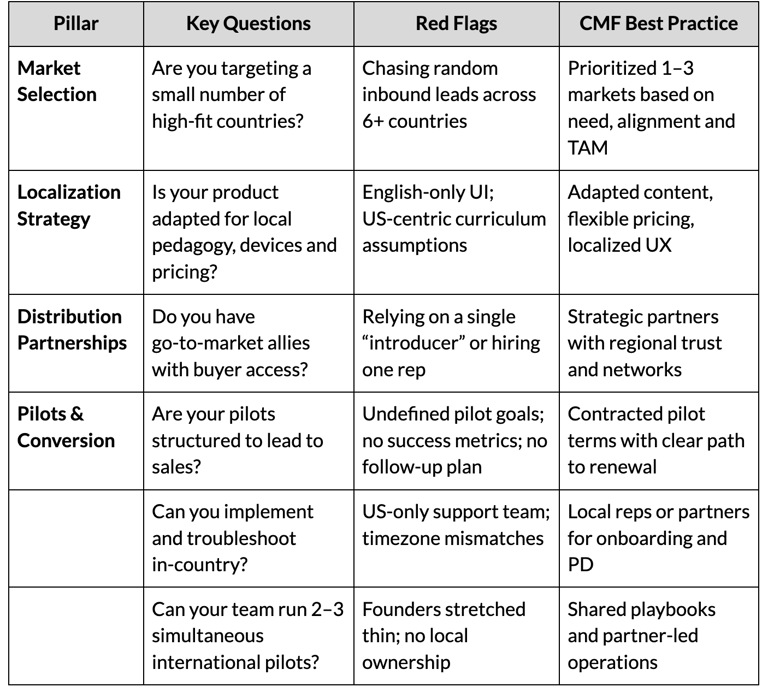
Bearing all the previous questions in mind, here’s a diagnostic that you can use to evaluate your readiness to expand globally:
If you’re waving red flags on two or more of these categories, it’s a signal that even if you find PMF, your company will still struggle to scale. The answer isn’t to hold off on going global. It’s to start building the infrastructure now to succeed when you do.
The truth that many founders I have seen learn too late is that it’s not just about having a great product. It’s about building a business that can thrive in the operating conditions of real, complex education systems — systems that vary wildly country to country, and buyer to buyer. Global Expansion Strategies has worked with dozens of edtech companies to unlock scale across LATAM, MENA and Southeast Asia, converting pilots to ARR within 6-12 months thanks to deeper CMF alignment. We’ve seen it work. And we’ve seen what happens when it’s missing.
So if you’re an edtech founder looking beyond the US to that $10tr global opportunity, ask yourself: do I have Product-Market Fit or do I have Customer-Market Fit? You need both to build a sustainable business.
All rights reserved. 2026
Email: hello@opulenceglobalpr.com