The Art of Intentional Branding: Planning Your Brand Year with Precision
A strong annual branding plan starts with a clear vision, then breaks that vision into focused, measurable projects you can actually execute over 12 months. Use the year to deliberately upgrade how your brand looks, sounds, and shows up across every touchpoint.
BRAND VISIBILITYMEDIA & PR STRATEGYDIGITAL MARKETINGPERSONAL BRANDINGCONTENT STRATEGY
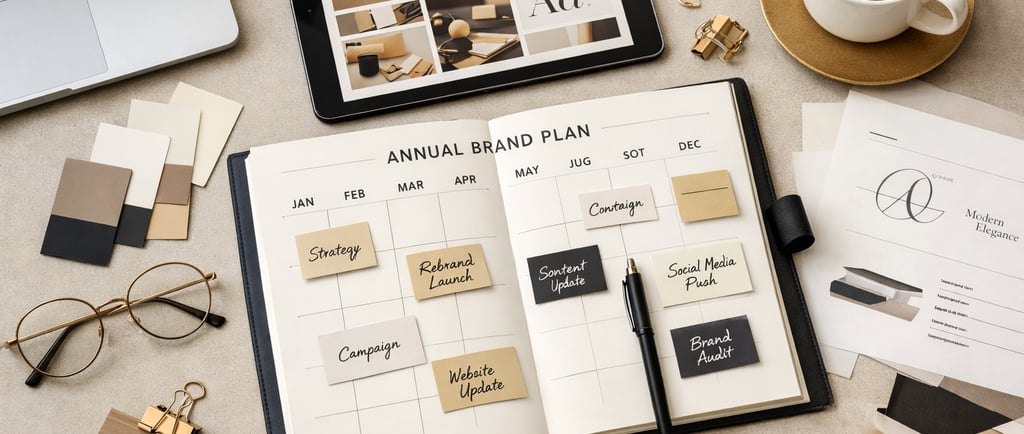
Clarify vision and brand position
Begin by getting brutally clear on what your brand should stand for and where you want it to be in 12–36 months. This anchors every decision and stops you from chasing random tactics.
Define your brand purpose, mission, and values in one page so everyone on the team can repeat them.
Decide your positioning: who you serve, what problem you own, and why you are different in simple, concrete language.
Audit last year and current brand
Before planning, dissect what already exists so you build on strengths instead of starting from zero.
Review last year’s numbers: leads, sales, traffic, social growth, PR wins, content output, and brand search volume to see what actually moved the needle.
Audit touchpoints (website, socials, pitch decks, proposals, CRM emails, profiles) for consistency in visuals, tone of voice, and messaging.
Set sharp annual brand goals
Translate vision into a small set of measurable outcomes for the next 12 months. Fewer goals executed well will level you up more than dozens of scattered experiments.
Use 3–5 SMART goals tied to brand health and revenue, such as increasing branded search, inbound leads, or authority indicators like speaking and press.
Connect each goal to 1–2 key metrics and a simple “scoreboard” you review monthly or quarterly.
Choose 3–5 core brand initiatives
High-performing brands concentrate resources on a small number of strategic initiatives instead of doing everything.
Examples: rework visual identity, launch a flagship content platform (podcast/blog/YouTube), build a thought-leadership PR engine, or redesign the website for conversions.
For each initiative, define clear strategies (how you will win) and supporting tactics (what you will do week to week).
Upgrade your visual identity
A focused refresh can instantly level up perception without a full rebrand.
Refine color palette, typography, and imagery so they align with your current target audience and price point, then roll them out across all assets.
Create a small brand kit: logo variations, color codes, fonts, and social templates to maintain consistency as you scale content.
Sharpen your brand messaging
Magnetic messaging turns brand strategy into words your market remembers.
Craft core messages: one-liner, elevator pitch, differentiators, proof points, and signature stories that show your values and personality.
Adapt these messages for each key audience segment and main platform (website, LinkedIn, email, podcast, etc.).
Build a simple content and platform plan
Your brand grows where you consistently show up with value.
Pick one primary platform for original content (e.g., LinkedIn, YouTube, podcast) and 2–3 secondary platforms where you repurpose.
Create a quarterly content calendar aligned to campaigns, launches, and seasonal moments your audience cares about.
Integrate PR and authority-building
Brand elevation comes from being seen in the right rooms, not just posting more.
Plan a yearly PR calendar around thought-leadership pieces, guest podcasts, industry reports, and strategic collaborations.
Anchor your visibility around a few signature topics and frameworks that you repeat often enough to “own” them in your niche.
Plan quarterly reviews and adjustments
Treat your brand plan as a living document, not a static file.
Schedule quarterly reviews to track progress, retire tactics that are not working, and double down on channels or messages that outperform.
Keep your plan to one page that covers vision, goals, key issues, strategies, and top tactics so the team actually uses it.
Sample yearly structure you can adapt
Here is a simple way to structure your year around brand growth.
Q1: Deep audit, refine positioning and messaging, confirm visual refresh priorities, design your one-page brand plan.
Q2: Roll out visual updates, relaunch website or key funnels, start consistent content engine on your primary platform.
Q3: Layer in PR, partnerships, and events; push authority-building assets like reports or signature frameworks.
Q4: Optimize based on data, tighten systems, and design next year’s brand roadmap from a stronger baseline.
All rights reserved. 2026
Email: hello@opulenceglobalpr.com